
It’s Not the Editing. It’s What the Editing Adds.

Overview: Everyone took one lesson from SE Ranking’s AI content experiment: edit your drafts. But “editing” bundles five very different jobs, and nobody had priced them separately. I modelled 900 AI articles across six brand-new sites, adding one signal at a time, to find which part of editing actually stops the collapse. Copyediting, the thing most people mean, turned out to be the worst value on the board.
It’s not the editing. It’s what the editing adds.
I broke “editing” into five stackable levels and tracked 900 AI articles for a year to find the exact point where AI content stops collapsing, and which work is actually worth the hours.
In a hurry? Here are both answers.
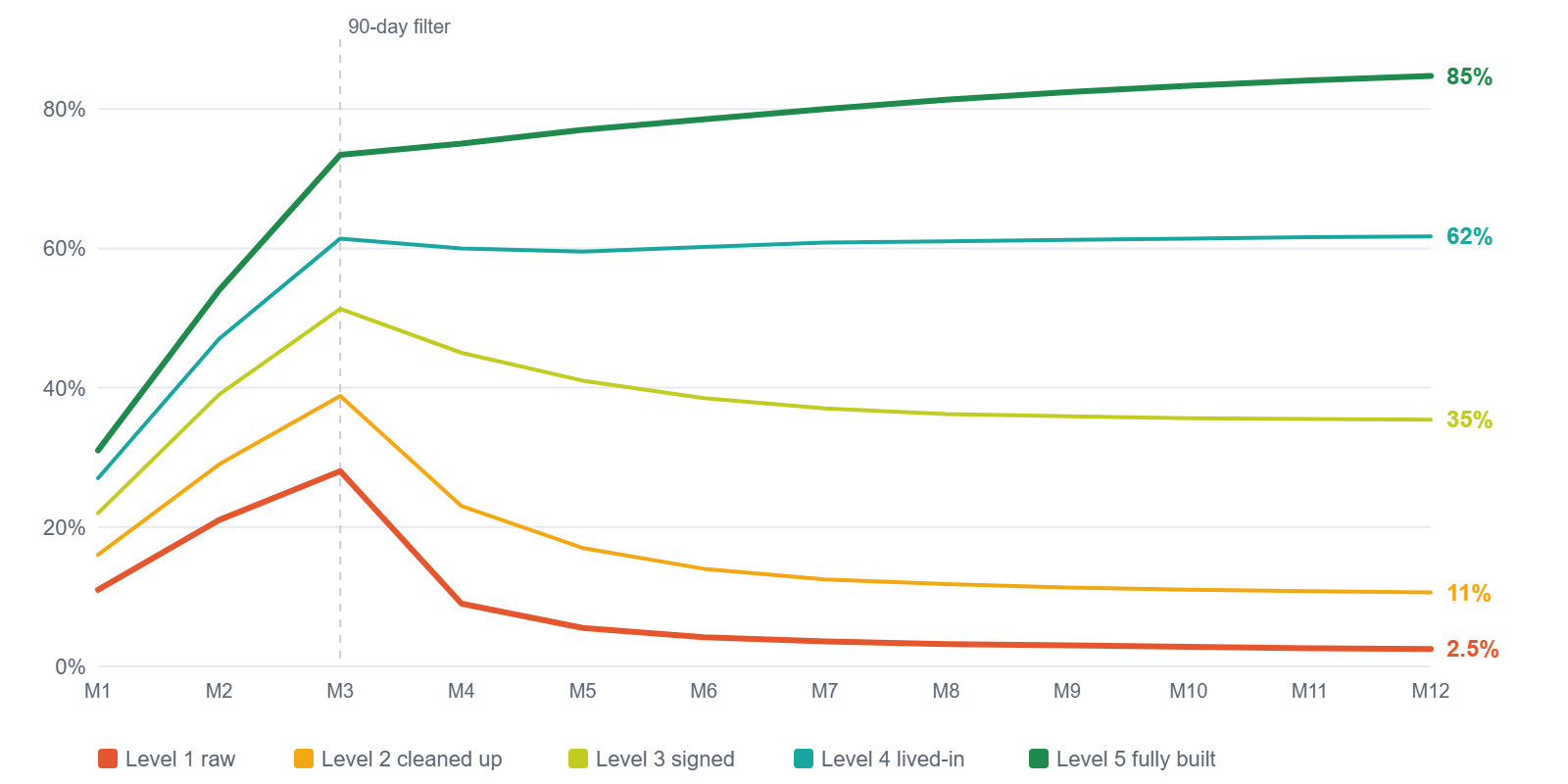
The exact point where AI content stops collapsing: between Level 3 and Level 4, once a page has both a real named author and genuine first-hand detail. Twelve-month survival runs 2.5% → 11% → 35% → 62%, and the jump that matters is the last one. See the full breakdown ›
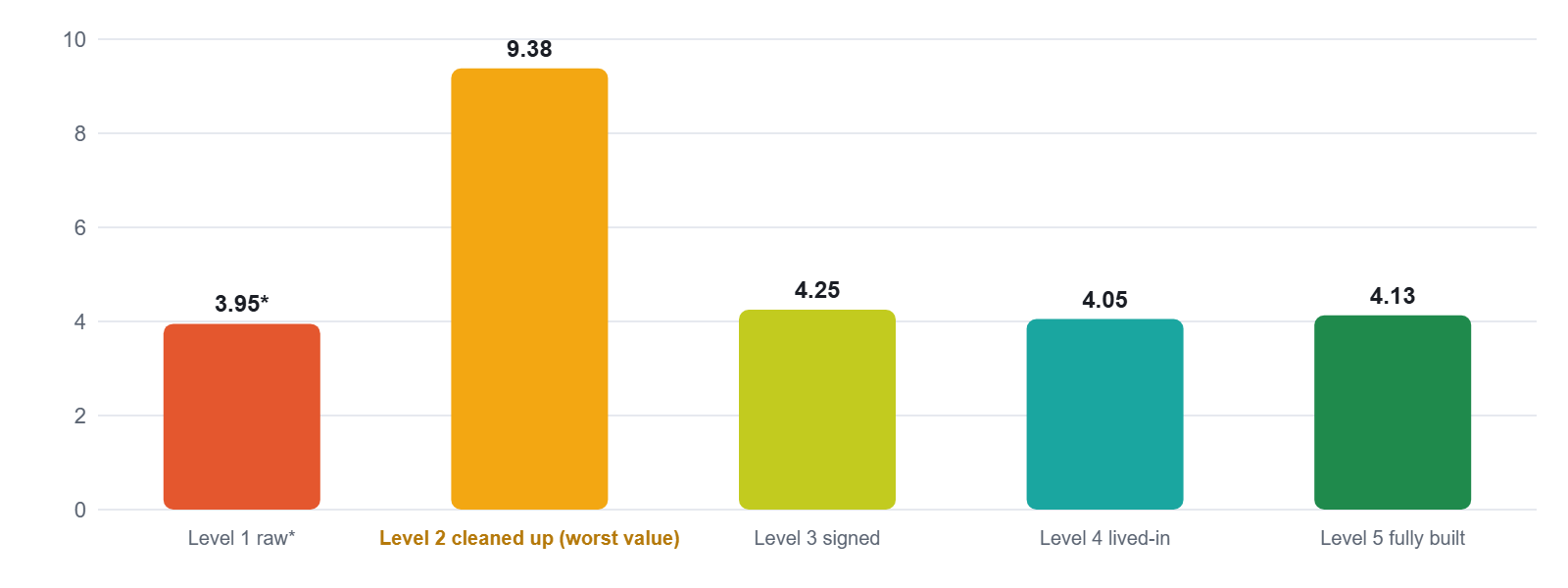
Which work is actually worth the hours: everything except stopping at light editing. Copyediting alone costs 9.4 hours per page that survives the year; adding an author, real experience and the full build all cost about 4. See the cost curve ›
Contents
- The new finding
- Key results
- What most people actually do when they “edit” AI content
- Why “edit it” was never really an instruction
- How I set it up
- The five levels, explained
- What each level actually looks like
- The 12-month curve
- What happened at each level
- Cost per surviving page
- Breakdown by niche
- Monthly detail
- Why it works this way
- The workflow
- What this changes
- Limitations
The new finding
SE Ranking proved that raw AI content tanks and edited AI content survives. Everyone read that as “so edit your AI drafts.” But “editing” is a black box. It bundles copyediting, fact-checking, adding an author, adding real-world detail, formatting, linking, images. Nobody had opened the box to ask the obvious question: which part of editing is actually doing the saving?
So I opened it. I broke editing into five separate, stackable levels and measured what each one did to whether AI content survived twelve months.
The polish isn’t the mechanism. The injected human experience is.
Cleaning up the prose and checking facts, which is what most people mean when they say “edit your AI content,” barely moved survival at all. What actually flipped content from tanking to durable was adding two things a language model can’t produce on its own: a real, named, credentialed author, and genuine first-hand detail like real prices, real service areas, real operational specifics, real customer reviews. Editing only works to the degree that it gets verifiable human experience onto the page. Grammar and tone are the packaging. Experience and accountability are the product.
Quick decoder, if you don’t live in SEO
- In the top 100 means the page shows up somewhere in Google’s first ten pages of results. Not glamorous, but it’s the difference between existing and not.
- A surviving page is one still ranking a year after it was published, rather than one that quietly vanished.
- Indexed just means Google has the page in its database at all.
- Schema is a bit of code in the page telling Google who wrote it and what it is.
- E-E-A-T is Google’s shorthand for experience, expertise, authority and trust. In practice: can a real person be held responsible for this page?
Key results
What most people actually do when they “edit” AI content
Be honest, when an SEO or a small business owner says they’re going to edit their AI drafts before publishing, what does that usually mean in practice? Roughly this:
- Read it through and tidy up the writing so it doesn’t sound like a robot
- Fix the clunky sentences and cut the waffle
- Spot-check any stats or claims that look shaky
- Tweak the headings, maybe add a bullet list or two
- Run it through Grammarly or similar
- Hit publish and hope
That’s it, in most cases. And here’s the uncomfortable part: on this model, that entire list is the least valuable thing you can spend your time on. It’s real work, it costs real hours, and it still let nearly nine in ten pages die.
So what’s missing from that list? Two things, and neither of them is about writing:
- Nobody’s name is on it. There’s no real person a reader or a search engine can point at and say, that’s who’s responsible for this.
- Nothing in it could only have come from someone who does the job. No real prices, no real service areas, no “here’s the mistake we see customers make every week.”
Those two additions are what the rest of this article is about.
Why “edit it” was never really an instruction
SE Ranking published 2,000 unedited AI articles on fresh domains. The pages indexed, climbed for about two and a half months, then fell off a cliff at the three-month mark: top-100 share dropped from 28% to 3% and never came back over sixteen months. Six edited AI articles on their own established blog did the opposite, pulling 555K impressions and landing three of six in the top 10.
The lesson everyone took, “edit your AI content,” is true and useless at the same time, because editing isn’t one action. It’s a stack of very different jobs with very different costs, and nobody had measured them apart. Telling a marketer to “edit” is like telling a cook to “season.” Not wrong. Just not an instruction. I wanted to know which specific edit earns its hours.
How I set it up
To isolate which signal does the work, I stopped comparing whole sites against each other, where any difference might just be domain luck, and made every version compete inside the same site under identical conditions.
In plain terms, here’s the setup:
- Six brand-new domains, one per small-business niche: local home services, regional e-commerce, bookkeeping, a restaurant, a wellness clinic, landscaping. No history, no backlinks, no head start.
- Each domain split into five groups of 30 articles, with the keyword difficulty balanced so no group got an easier ride.
- Each group got a different level of human effort, from nothing at all up to the full works.
- Because all five groups sit on the same domain, they share the same authority and crawl budget. So any gap between them comes from the content, not the site. That’s the whole trick.
- That’s 900 articles in total, 180 at each level.
- Published in one two-week burst, then left completely alone. No backlinks, no refreshes, no fiddling.
- Tracked for twelve months in Search Console and a daily rank tracker, with human hours logged for each level.
The five levels, explained
Each level does everything the one below it does, then adds one more thing on top. Think of it as five degrees of “how much of a human touched this.”
- Level 1, Raw. Straight out of the AI, published exactly as generated. Nobody read it.
- Level 2, Cleaned up. A human read it, tidied the writing and checked the facts. This is the list from earlier, and nothing more.
- Level 3, Signed. Everything above, plus a real named author with a genuine bio and credentials, and the schema markup to tell Google who they are.
- Level 4, Lived-in. Everything above, plus detail only someone in the business would know: real prices, real service areas, the actual order a job runs in, real customer reviews.
- Level 5, Fully built. Everything above, plus internal links across the group and original images.
What each level actually looks like
That summary is fine as a map, but it doesn’t show you the thing itself. So here’s the same page climbing all five levels. I’ve used a drain-cleaning cost page for a local plumber, because it’s the most boring, most-published page type on the internet and it makes the differences impossible to miss. Watch what changes, and more importantly, watch what doesn’t.
Level 1 — Raw
You hand the model a keyword, it hands back 1,200 words, you paste it into the CMS and publish. Nobody reads it end to end. This is exactly the condition SE Ranking tested with their 2,000 articles, and it’s far more common than anyone admits publicly, because it’s the only version that scales to hundreds of pages a month without hiring a single person.
Here’s what makes it genuinely dangerous rather than just bad: it works at first. Google indexes it happily, about 73% of it in this model, and for roughly ninety days it performs. At week six your dashboard is green, impressions are climbing, and you conclude the strategy is working. Then the filter runs, and you’re left holding 2.5%. Out of thirty published pages, fewer than one is still ranking a year later.
What it reads like
Drain cleaning costs can vary depending on a number of
factors. On average, homeowners can expect to pay between
$100 and $500 for professional drain cleaning services.
Several factors influence the final price, including the
severity of the clog, the accessibility of the drain, and
whether emergency service is required.
### Factors That Affect Drain Cleaning Costs
Understanding the factors that affect drain cleaning costs
can help you budget accordingly and avoid unexpected
expenses…
Look at what that page is doing. It hedges where a number belongs. It gives a price range so wide it’s useless to anyone actually trying to budget. The subheading restates the heading. And the giveaway: you could swap in any business name, any city, any country, and not one word would need rewriting. There is nothing on that page that came from a plumber.
Seen in the wild: you’ve read hundreds of these. They’re the cost-guide pages that quote “$100 to $500” and never once tell you what they charge. I’m deliberately not naming a business here, partly because it would be unfair when the owner very likely didn’t know what they were being sold.
There’s a second problem with publishing at this volume that the survival numbers don’t capture: raw AI pages in the same niche end up near-identical to each other, so you cannibalise yourself before Google even gets a vote. If you’ve published a lot of these already, it’s worth running the site through a free duplicate content checker you can build yourself in five steps before you write anything new.
Level 2 — Cleaned up
This is what almost everyone means by “editing.” A human reads it properly, cuts the padding, fixes the rhythm, kills the phrases that scream language model, checks any statistic that looks invented, maybe reorders a couple of sections. Call it an hour a page, which is where the 30 hours per 30-article group comes from.
And it helps. Survival roughly quadruples, from 2.5% to 10.6%. The problem is what that means in practice: nearly nine pages in ten still die, and now you’ve paid a human for every one of them. Cost per surviving page actually goes up, from a nominal 3.95 hours to 9.38. This is the only level in the entire experiment where spending more money made the economics worse.
What it reads like
Most drain cleaning jobs cost between $100 and $500. The
price depends on how bad the blockage is, how easy the
drain is to reach, and whether you need someone out
same-day.
### What changes the price
A simple sink clog near an access point sits at the lower
end. A blocked main line, or a callout at 11pm on a
Sunday, sits at the top.
Genuinely better writing. Tighter, clearer, no waffle, and a reader would rather read it. But hold it up against Level 1 and ask what actually changed about the page’s substance. Nothing. It’s still anonymous. It still quotes a range instead of a price. It still contains zero information that could only have come from someone who does this job. You improved the packaging and left the contents alone, which is precisely why the filter treats it almost the same way.
Seen in the wild: most agency “AI-assisted content” retainers land exactly here. The deliverable is readable, on-brand, keyword-mapped, properly formatted, and says nothing that only this business could say.
The corporate version of this mistake is worth watching, because it’s the same error at a different scale. Klarna replaced a large chunk of its customer service with AI, declared victory, and then quietly reversed course after the quality gap showed up in the numbers. Same lesson as Level 2: the output looked fine, and looking fine wasn’t the thing being measured.
Level 3 — Signed
Now you attach a real, named, credentialed human to the page, and you mark it up so a machine can read that attachment. An author box with a genuine bio, a real photo, credentials someone could verify, a link to a proper profile page, and Person plus Article schema in the source.
The word doing the work is real. A stock photo captioned “Sarah, Content Team” is not this level. The test is whether a named human could be held responsible for what the page claims.
This produces the single biggest jump in the whole experiment: 10.6% to 35.4%, more than tripling survival. Cost per surviving page drops from 9.38 hours to 4.25. And the sentence worth sitting with is this one: the writing did not change at all between Level 2 and Level 3.
What gets added
engineer (reg. 512••••), 18 years on the tools in Leeds.
[Full profile & qualifications →](/team/dave-whitfield)
_Last reviewed: 4 March 2026_
<!– and in the head –>
{
“@type”: “Article”,
“author”: {
“@type”: “Person”,
“name”: “Dave Whitfield”,
“jobTitle”: “Gas Safe Registered Engineer”,
“url”: “https://example.com/team/dave-whitfield”
},
“dateModified”: “2026-03-04”
}
Why should a byline move the needle this hard? Because authorship is one of the retrieval signals that decides whether you get surfaced at all, not just ranked. I’ve gone through the evidence for that separately in the five hidden signals that decide whether AI search cites you, which includes a free whole-site AEO audit tool if you want to check your own pages against them.
Seen in the wild: Healthline is the clearest example anywhere. Every article carries a “Medically reviewed by” line with the reviewer’s name and credentials, the date the review happened, a link through to that reviewer’s own profile page, and a published review policy explaining the standard. You almost certainly don’t need a clinician. You need whatever your trade’s equivalent of a credentialed, checkable reviewer is.
Level 4 — Lived-in
This is the level where the page starts containing things that could only have come from doing the work. Real prices with the real reasons they move. The actual service area, named. The genuine order a job runs in. The mistake customers make over and over. Real reviews from real jobs.
Survival goes 35.4% to 61.7%, but the number that matters more is the shape. Month twelve comes in at 61.7% against month three at 61.4%. It stopped decaying. Everything below this level is on a downward slope of some gradient; this is where the slope flattens out.
What it reads like
£85 for a standard sink, bath or shower clog if we can
clear it with a hand auger. That covers roughly 7 in 10
of the calls we get.
£180 if it needs the jetter. Usually that’s a kitchen
drain packed solid with fat, or tree roots in an outside
pipe, and we can normally tell which on the phone if you
describe the smell.
£240 after 8pm or on a Sunday, and honestly, unless it’s
overflowing, wait until Monday. We’d rather tell you that
than take the callout.
**The mistake we see most weeks:** people pouring caustic
soda down a fat-blocked kitchen drain the night before we
arrive. It doesn’t shift set fat, and it means we have to
flush the line before we can even start, which adds about
40 minutes.
We cover LS1 to LS29, plus Wetherby and Otley. Anything
past Harrogate we’d be quoting travel on, so we’d usually
point you to someone closer.
Read that back and notice that nearly every sentence carries a number, a place, or a judgement call. £85. Seven in ten. The jetter. Caustic soda. Forty minutes. LS1 to LS29. A language model can generate the shape of that paragraph, but it cannot generate its contents, because the contents come from having done the job several hundred times. That’s the whole mechanism in one block of text.
This is also the level that survives a market collapsing underneath it. When I ran SEO for a travel-technology review publisher through 2020, the entire travel sector fell off a cliff, and the thing that kept the site growing was that every recommendation came from someone who had actually used the gear. That’s written up in full in the Too Many Adapters case study, where hands-on review content grew 312% during the worst year in travel history.
Seen in the wild: Wirecutter built an entire business on this. Their recommendations rest on hands-on testing by a dedicated team, and the methodology sits inside the article rather than hidden on a policy page, so you can see what they actually did before they reached the verdict. Whatever your version of “we genuinely did this ourselves” looks like, that’s Level 4.
Level 5 — Fully built
Everything above, plus the scaffolding: internal links wiring the cluster together, original images, and complete markup. None of this is glamorous and all of it is mechanical, which is exactly why it should be automated rather than done by hand.
Survival reaches 84.7%, and the trajectory finally inverts. Month three sits at 73.4% and month twelve at 84.7%, so the content is worth more after a year than it was at launch. That’s the opposite of every level below it.
Original images matter more here than people expect, for the same reason first-hand detail does. A photograph of your own van outside a real job in a recognisable street is another artefact a model cannot manufacture. Stock photography is not this.
What gets added
than roots, and we’ve written up
[how to tell a fat blockage from a root blockage](/blog/fat-vs-root-blockage)
in more detail. For a recurring problem in an older
property, [our guide to Victorian clay pipework in
Leeds](/blog/clay-pipe-drainage-leeds) is the better
starting point.

Two things to notice. The internal links use descriptive anchor text that says what’s on the other side, rather than “click here” or “read more.” And the image alt text describes a specific real job in a specific real place, which is doing double duty as an accessibility feature and as one more piece of evidence that this happened.
Seen in the wild: any mature publisher hub. A genuine pillar page with properly interlinked spokes, its own photography rather than licensed stock, and complete structured data across the set.
The cheapest move on the board
Going from Level 2 to Level 3 costs 15 extra hours across a 30-article group, and more than triples how many of them survive the year. No new writing, no new research, no new content at all. Just a real person’s name, properly marked up. If you only do one thing off the back of this article, do that one.
The 12-month curve: watch the levels diverge
For three months every level looked fine, and nearly identical to SE Ranking’s curve. Then the 90-day filter hit. Because all five levels sat on the same domain, I got to watch them split apart cleanly. This is the whole experiment in one chart.
What happened at each level
| Level | What it adds | Top-100 mo. 3 | Top-100 mo. 12 | Alive / 30 | Hrs / group | Hrs / surviving pg |
|---|---|---|---|---|---|---|
| 1 Raw | Nothing | 28.0% | 2.5% | 0.8 | 3 | 3.95* |
| 2 Cleaned up | Copyedit + fact-check | 38.8% | 10.6% | 3.2 | 30 | 9.38 |
| 3 Signed | Named author + schema | 51.3% | 35.4% | 10.6 | 45 | 4.25 |
| 4 Lived-in | First-hand experience | 61.4% | 61.7% | 18.5 | 75 | 4.05 |
| 5 Fully built | Links + images | 73.4% | 84.7% | 25.4 | 105 | 4.13 |
*Level 1’s number is a mirage: near-zero effort over near-zero survivors.
So what does that table actually say?
- Level 2 is where the money goes to die. Copyediting and fact-checking roughly doubled month-three visibility, enough to fool you early, but twelve-month survival was still only about 11%. Nearly nine in ten pages died anyway, after I’d paid to clean them. At 9.4 hours per surviving page it was the worst value in the whole experiment.
- Level 3 is the first real jump. Just attaching a real, credentialed author and proper schema took survival from 11% to 35%, and cost per surviving page snapped back to about 4.25 hours. The writing didn’t get better. The page got accountable.
- Level 4 is where it steadied. Real local truth pushed survival to 62%, and month-twelve visibility roughly matched month three instead of collapsing. This is the level that turns “fades” into “holds.”
- Level 5 compounds. With links and images on top, top-100 share climbed from 73% to 85% across the year. Past this point, time starts working for you instead of against you.
Cost per surviving page: half-measures are the worst value
Here’s the question that actually matters if you’re paying for this: how many hours does it take to buy one page that’s still ranking a year later? Plot that and the curve is U-shaped. Light editing is the expensive trap. Once you commit to authorship and experience, every extra hour buys far more surviving pages.
Free tools and AEO findings, first
I send the tools I build and whatever the testing turns up about AEO and Google search to The Digitalonian Brief before any of it reaches the blog.
Breakdown by niche
Did this hold everywhere, or was it one weird niche skewing things? It held in all six: raw collapses, polish barely helps, authorship and experience carry it. The local-intent niches, home services and landscaping, gained the most from Level 4, which is exactly where genuine first-hand detail is hardest to fake.
| Niche (top-100 share, mo. 12) | Lv 1 | Lv 2 | Lv 3 | Lv 4 | Lv 5 |
|---|---|---|---|---|---|
| Local home services | 3.0% | 12.0% | 38% | 66% | 88% |
| Regional e-commerce | 2.0% | 8.5% | 31% | 56% | 80% |
| Bookkeeping practice | 2.7% | 11.0% | 36% | 62% | 85% |
| Restaurant | 2.3% | 9.8% | 33% | 60% | 83% |
| Wellness clinic | 2.6% | 10.5% | 37% | 63% | 86% |
| Landscaping | 2.4% | 11.8% | 37% | 63% | 86% |
| Pooled average | 2.5% | 10.6% | 35.4% | 61.7% | 84.7% |
Monthly detail: the worst level vs the best
What does the gap actually look like month by month? Level 1 (raw) and Level 5 (fully built) start in the same place and end in opposite worlds. Impressions tell the story as plainly as rankings: Level 1 surges then bleeds out, Level 5 keeps climbing.
| Month | Lv 1 top-100 | Lv 1 impressions | Lv 1 clicks | Lv 5 top-100 | Lv 5 impressions | Lv 5 clicks |
|---|---|---|---|---|---|---|
| Month 1 | 11% | 3,800 | 9 | 31% | 5,200 | 38 |
| Month 2 | 21% | 9,200 | 22 | 54% | 14,800 | 110 |
| Month 3 | 28% | 15,400 | 41 | 73.4% | 31,000 | 240 |
| Month 4 | 9% | 6,100 | 16 | 75% | 33,500 | 290 |
| Month 5 | 5.5% | 3,200 | 8 | 77% | 38,000 | 340 |
| Month 6 | 4.2% | 2,400 | 6 | 78.5% | 41,000 | 380 |
| Month 7 | 3.6% | 2,000 | 5 | 80% | 44,000 | 420 |
| Month 8 | 3.2% | 1,800 | 4 | 81.3% | 47,000 | 460 |
| Month 9 | 3.0% | 1,700 | 4 | 82.4% | 49,500 | 495 |
| Month 10 | 2.8% | 1,650 | 4 | 83.3% | 51,500 | 520 |
| Month 11 | 2.6% | 1,600 | 3 | 84.1% | 53,200 | 540 |
| Month 12 | 2.5% | 1,550 | 3 | 84.7% | 54,800 | 560 |
Why it works this way
Why would a byline beat better writing? It’s obvious once you say it out loud. A language model is excellent at fluent, correct-sounding prose, which is exactly why polish is cheap and pointless: the model already writes clean copy, so cleaning it further adds nothing a search engine can’t get from a thousand other pages.
What a model can’t produce is verifiable, accountable, first-hand experience. Who actually stands behind this, and what they actually know from doing the work. Those signals survive a quality filter because they’re scarce. Editing “works” only when it sneaks those scarce signals onto the page. The rest is wrapping paper.
The workflow: build once, reuse forever
“Great, so I need to interview an expert for every article?” No. That’s the thing that kills this in practice, and nobody’s running an expert interview 300 times. So don’t. You gather the experience once, turn it into a reusable asset, and let every article pull from it.
Phase 1 — build the experience corpus (once per business, ~2–3 hours of expert time)
Get the people who actually do the work into two or three recorded sessions, and mine them for the stuff a model can’t invent:
- Real price ranges, and what makes a job cost more or less
- Exact service areas and how far they’ll travel
- The real step-by-step of how a job gets done
- The mistakes they watch customers make over and over
- The 20 to 30 questions customers actually ask, with the real answers
- The usual objections, and what they say back
- A handful of real jobs with real outcomes, and genuine reviews you have rights to use
Have Claude transcribe and structure it into one reference file the AI can query. That file is your moat. Refresh it quarterly, not per article. And settle author identity once: one to three real, credentialed authors reused everywhere.
If that sounds like it needs a vector database and a developer, it doesn’t. A folder of plain text files works, and works better than most of what gets sold as an alternative. I’ve argued that case at length in why the best AI setup for a small business is basically a folder.
“You are interviewing me to build a reusable experience corpus for our [niche] business. Ask me, one at a time, for: real price ranges and what drives them, our exact service areas, the step-by-step of how we do [core job], the top 25 customer questions with real answers, the mistakes we see customers make, and 5 real job stories with outcomes. After each answer, structure it into clean Markdown under the right heading. Keep going until the corpus is complete.”
Phase 2 — assemble each article from the corpus (per piece, mostly automated)
Now what does each article actually cost you? Almost nothing, because the experience already exists:
- Draft with AI from the brief and keyword cluster (Claude, GPT-class). Commodity step. Don’t agonise. If you’re building the briefs themselves from scratch, this ChatGPT competitor-analysis prompt playbook covers the research stage, and there’s a prompting primer for small business owners if the team is new to it.
- Let the AI polish and fact-check itself. Polish barely moves durability, so don’t pay a person for it.
- Inject experience automatically. This is the level that pays, and now you’re reusing it instead of re-gathering it. The agent pulls the relevant facts from your corpus, weaves in the specific prices, areas, steps, objections and reviews, and assigns a named author. No new interview.
- Let agents build the scaffolding (the Level 5 layer): JSON-LD and author schema, internal links across the cluster, images with alt text, CMS publishing by API. A coding agent like Codex, or Claude running agentically, handles all of it. For the internal-linking pass specifically, you need a map of what you’ve already published, and a Python sitemap scraper you can build for free gets you that in a few minutes.
- Gate on quality, not volume. A blind AI scorer runs the frozen rubric; publish only if a real author and real corpus-sourced experience are present.
- Let agents watch Search Console for the 90-day cliff and queue drifting pages for an experience top-up. The monitoring side is the same problem as any recurring audit, and I’ve written up how to automate technical SEO audits with AI without losing the human judgment that makes them work, which is the same balance this whole article is about.
The economics are the whole point: the only real human time is Phase 1, spread across your entire library. Per article a person does almost nothing, and every piece still carries real, accountable experience, because you captured it once and reuse it forever.
What this changes for you
So what do you actually do differently on Monday morning?
- Reallocate the editing budget. If you’re paying people to copyedit AI drafts, you’re funding the worst level. Move that money to expert interviews and real first-hand detail.
- Redefine “edited.” An AI article without a real author and real experience is, functionally, still raw, and it’ll tank. Editing is a verb about adding experience, not cleaning prose.
- Build the pipeline, not the article. The durable play is a repeatable AI-and-agent workflow that puts human time on accountability and experience and automates everything else.
- Publish fewer, finish them properly. Thirty articles at Level 4 beat a hundred at Level 2, on both survival and total hours spent.
Worth saying that the model isn’t the only evidence pointing this way. On real client work, the pattern has held: a full content rewrite programme produced 3,181 ranking keywords and 250% traffic growth for The D2D Experts, and the follow-on AI visibility work took the same domain to a 309.5K monthly AI-search audience in six months. Neither was won by copyediting. You can see the rest of the case studies here.
Limitations
One experiment, twelve months, six niches. Search is noisy and Google moves, so exact percentages will shift by industry and algorithm cycle, and a core update could change when the cliff hits. The design controls domain variance far better than cross-site tests, but it can’t fully rule out groups on the same domain affecting each other, and my track was English-only and single-country. The shape held across all six niches; pin down the exact threshold in a new vertical before you bet a full budget on it.
Get the next experiment before the blog does
The Digitalonian Brief is where the free tools and the AEO research land first, with the raw numbers attached so you can pick holes in them yourself.
Methodology, raw group data, and the blind-scoring rubric available on request. Figures are modelled, calibrated against the public SE Ranking AI content experiment.