
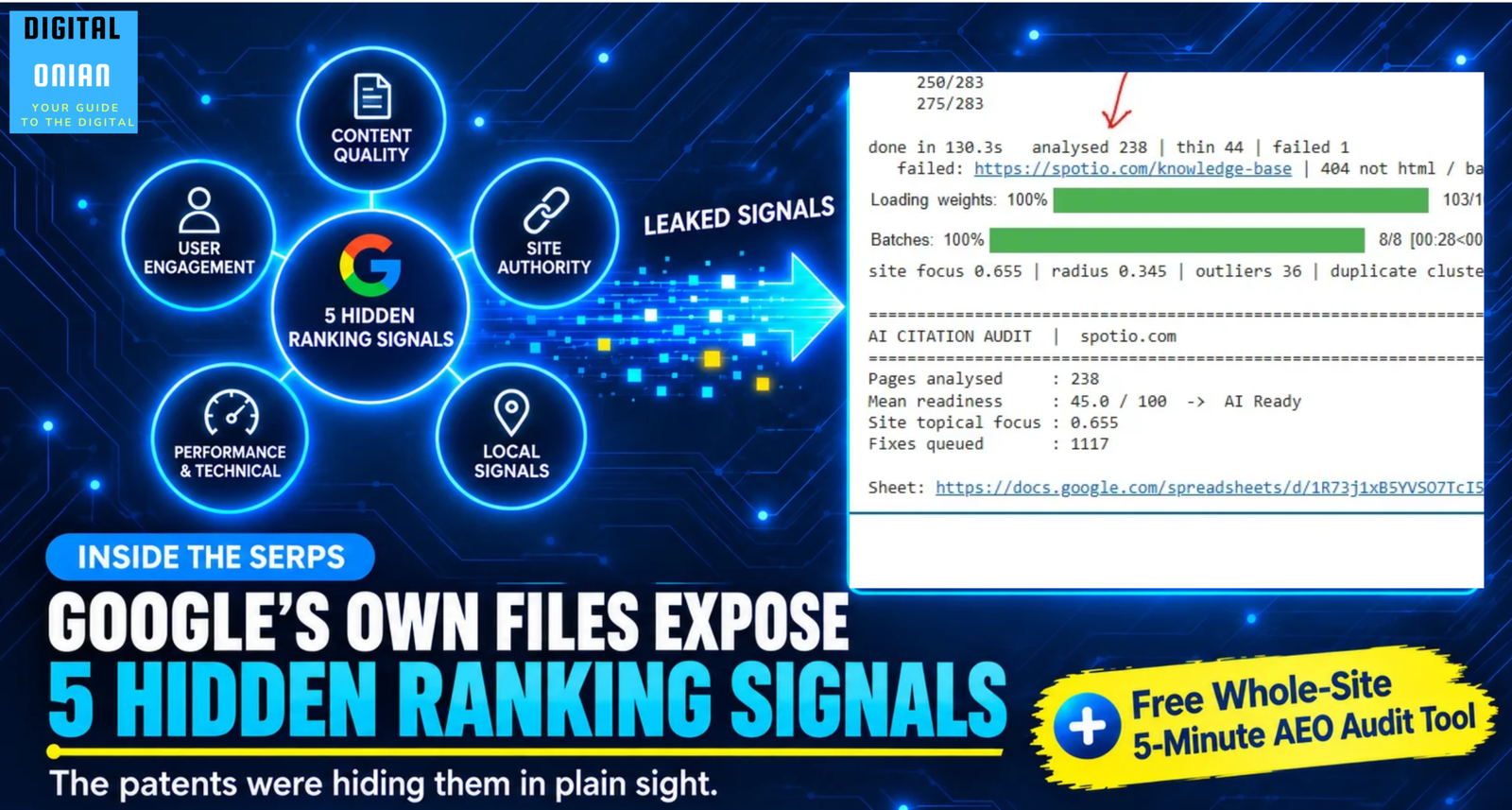
Google’s 5 Hidden Signals That Decide If AI Search Cites You + Free Whole-Site 5-Minute AEO Audit Tool

- AI answers retrieve from Google’s index before they generate, so the signals governing retrieval govern which three sources get cited.
- Google’s public guidance and its internal systems diverged for over a decade on click data, site-level scoring and new-host suppression. Sworn testimony confirmed the first, leaked index documentation the second. The third is the one the industry got wrong.
- Five signals hold up under checking: topical focus, quality consistency, estimated content effort, information gain, and sustained external referencing.
- Information gain is the most misread. It scores novelty against what the reader has already been shown, which is exactly how a three-source AI answer is assembled.
- Two widely repeated claims don’t survive the primary sources, and one circulating “update” is fabricated.
The signals Google spent a decade telling the industry to ignore are the ones now deciding whether an AI assistant cites you.
It isn’t about ranking you, it’s about citing you, and those are different outcomes. When someone puts a question to an AI assistant and gets an answer back with three linked sources, those three slots are the entire prize. Positions four through ten have quietly stopped existing, and the selection that fills those slots happens earlier in the pipeline than almost any SEO advice is aimed at.
Which makes it worth revisiting what’s actually on the record, because the record is better than the commentary.
I had a selfish reason for building it. I audit low-volume client sites, and the first version of this ran every page through Claude. It worked. It also cost more than those sites could justify, and it returned slightly different answers on the same page from one run to the next, which is a bad property in an audit. So I rebuilt it as a deterministic workflow: every check that can be settled by a rule is settled by a rule, in Python, at effectively zero marginal cost per site. Same input, same output, every time. That is what makes it repeatable across a stack of small sites instead of a one-off, and it is free at the end of this piece. First, what the record says.
For years the public guidance was consistent: clicks aren’t a ranking factor, there’s no site-wide authority score, there’s no sandbox for new domains. Then in the 2023 antitrust trial, Google’s VP of Search testified under oath about Navboost, a system that re-ranks results using aggregated click data on a rolling 13-month window. He described it as one of the important signals. That’s a considerable distance from “clicks aren’t a ranking factor.”
In May 2024 the Content Warehouse API documentation leaked, and with it a schema full of things that weren’t supposed to exist. Site-level quality stored as a standard deviation. Topic embeddings measuring how far each page drifts from the site’s centre. A model-generated estimate of how much effort went into an article.
That much has been covered thoroughly. What hasn’t is the obvious follow-on question: if these signals decide what Google retrieves, and AI answers are written from what Google retrieves, then these are citation signals, and reading them as ranking signals is reading them for the wrong outcome.
So I went to the primary sources. The leaked API reference for the field names, Google Patents for the actual claim language, the live Quality Rater Guidelines PDF for the quotes everyone paraphrases. Some of what’s circulating held up. Some of it fell over, including one thing Google was accused of that it appears not to be doing.
Why an index schema governs AI citations
Here’s the connection nobody spells out.
AI Overviews and AI Mode don’t generate from thin air. The system fans a query out into sub-queries, retrieves documents from Google’s own Search index, then writes an answer from what came back.
Retrieval is the gate, so if your page isn’t in the retrieved set then formatting it beautifully for LLMs changes nothing at all. Which means the signals deciding what gets retrieved are the same signals deciding what gets cited. It’s the same machinery you already know about, competing for a much smaller prize.
That reframe is why the hidden signals matter more now than they did in 2024, and it’s also why half the commentary about them is aimed at the wrong target.
Two limits before the list.
This is a Google-specific map. ChatGPT, Perplexity and Claude run their own crawlers and their own retrieval stacks, and no leaked field name tells you anything about them directly. The logic transfers, because every retrieval system needs some proxy for “is this source worth pulling in.” The field names don’t.
And leaked documentation is a schema, not an algorithm. These fields describe what Google stores. They say nothing about weight, nothing about whether a field is still live. A patent is weaker evidence still: it describes something Google was permitted to protect, not something Google necessarily shipped.
1. The denial about site-level scoring
For years the line was that Google evaluates pages, not sites. Two leaked fields make that hard to sustain.
siteFocusScore— “number denoting how much a site is focused on one topic.”siteRadius— “the measure of how far page_embeddings deviate from the site_embedding.”
Your site has a vector and so does each page, and the radius is simply the distance between the two. Whatever you want to call that, it’s site-level scoring by any reasonable definition.
One correction while we’re here: these aren’t NSR fields, and the leak never says they’re derived from site2vec. That connection is inference, repeated often enough to now read as fact.
What it means for citation. Retrieval has to choose which of forty pages on a subject to pull. A site where every page clusters tightly around one topic is a cleaner, more confident target than one covering your subject on Tuesday and something unrelated on Thursday.
This is the signal to care about if you’re small. You can’t out-authority a competitor with a ten-year head start. You can out-focus one this quarter, and the change shows up within a crawl cycle.
2. Quality is stored as a spread, not an average
siteQualityStddev— “estimate of site’s PQ rating stddev — spread of the page-level PQ ratings of a site.”
It’s a standard deviation, which means Google is keeping a measure of how inconsistent your pages are rather than how good the best ones are.
What it means for citation. Your archive is the corpus a retrieval system samples from. A site where quality varies wildly is a noisier sample than one that’s evenly decent, and noise is expensive at retrieval time. Twelve solid pages will do more for you than four excellent ones buried under sixty thin ones.
Which makes pruning the highest-leverage move available to most sites, and the only one that costs nothing to write.
3. Effort is estimated by a model
The field is contentEffort, in QualityNsrPQData. Google’s comment on it runs to nine words: “LLM-based effort estimation for article pages.”
That’s the entire documentation. Everything you’ve read about it scoring originality or custom graphics or citation density is somebody’s reasonable guess that hardened into fact through repetition. The leak never says what the model looks at.
Corroboration comes from a different direction. The Search Quality Rater Guidelines, live version dated 11 September 2025, define main content quality in section 3.2 as “the amount of effort, originality, and talent or skill that went into the creation of the content.” That phrasing has been stable since December 2022. It’s a five-tier ladder rather than a high-quality benchmark, and it’s disjunctive — effort, originality, talent, or skill. You don’t need all four.
What it means for citation. An assistant assembling an answer needs sources it can pull specific, checkable material from. A page that competently restates what five other pages say offers nothing to extract that the other five don’t. The fix isn’t length. It’s putting something in the page that could only have come from you: your own data, your own test, a number nobody else has published. That’s the raw material a citation is made of.
4. Novelty is scored against what the reader has already seen
US11354342B2, Contextual estimation of link information gain, granted 2022, still live with two continuations.
This is the patent behind the claim that Google rewards you for adding information competitors lack. It does say documents get re-ranked by an “information gain score” measuring how much new information they add.
But one qualifier changes the meaning completely. The score is measured relative to documents already presented to that specific user in that session, rather than against the corpus or against the SERP. Much of the patent’s framing is around assistant contexts specifically.
Every summary I’ve read drops that qualifier, and it’s the most important thing in the document.
What it means for citation. Because it describes exactly how a multi-source AI answer gets built. If an assistant pulls three sources in sequence, the third one is only worth including for whatever it adds to the first two, so a page that repeats them earns nothing.
Being the fourth competent explanation of a topic is the worst position on the internet, and it’s a position an enormous amount of well-optimised content occupies. The practical read: stop writing the definitive guide to something that already has four definitive guides. Write the part all four skip.
5. Links are read as a timeline
numOffdomainAnchors is documented — “the total number of offdomain anchors seen by the NSR pipeline for this page.” Two related fields, linkIncoming and deltaLinkIncoming, exist with completely empty comments, so any directional reading of those is inference.
The patent carries more weight. US7346839B2, filed 2003, explicitly covers monitoring “when links appear or disappear, the rate at which links appear or disappear over time… whether there is trend toward appearance of new links versus disappearance of existing links.”
A caveat the recaps never mention: this patent is expired. It grants no rights and proves nothing about what’s running now.
What it means for citation. Getting cited by a machine is downstream of getting cited by people. A link graph that stopped growing in 2023 reads as a source that stopped mattering in 2023, and a retrieval system choosing between two comparable pages has no better tiebreaker than whether anyone still refers to one of them.
The same patent covers something else worth knowing. It explicitly discounts cosmetic changes, listing “Javascript, comments, advertisements, navigational elements, boilerplate material, or date/time tags” as content that may be given little weight when updated. Changing 2025 to 2026 in a title was never the refresh it looked like, and that’s been public for twenty years.
Where the hidden-signals narrative overshoots
Three claims that would otherwise end up in your strategy.
There’s no general new-site sandbox in the leak. This is the one the story gets wrong. The hostAge comment gets quoted at half length. Whole, it reads: “the earliest firstseen date of all pages in this host/domain. These data are used in twiddler to sandbox fresh spam in serving time.”
Read whole, it says the data is used to sandbox fresh spam, which is a narrower claim than the one everyone quotes. The field is scoped to spam suppression, and domainAge is a separate field entirely. The sandbox was denied, and on this specific evidence the denial holds up rather better than the accusation does, which means new sites can be cited.
Nobody knows what contentEffort measures. Worth repeating because the guesses get published as checklists. Nine words of documentation, none of them about inputs. Any list of “what contentEffort rewards” is invented.
There is no June 2026 Quality Rater Guidelines update. Several sites currently describe one, introducing sections on “verifiable real world expertise” and “synthetic authority.” Those sections don’t exist. The live document is dated 11 September 2025 and its changelog goes no further.
That last one is the fabrication most likely to reach your draft, because it’s precisely the update everyone assumes has happened.
The ten checks you can actually measure
The five signals above explain why retrieval picks one source over another. They don’t give you a task list, and two of them can’t be seen from outside at all — Google’s internal effort estimate and its link-history data are not exposed to anyone.
So here is the part that is measurable. Ten checks you can run against any URL, each tagged with where its evidence comes from, because they don’t all come from the same place.
There are two evidence bases here and it matters a great deal which is which. The leak tells you what Google stores, and says nothing about how much weight anything carries or what effect it has. The Princeton GEO study did the opposite, testing nine content modifications across 10,000 queries and measuring the change in citation rate. Knowing something exists is not the same as knowing it moves the needle, and treating the two as interchangeable is the error this piece opened by calling out, so the table below says which is which.
| Check | Evidence | Effect |
|---|---|---|
| Inline citations to authoritative sources | Princeton GEO Study | +115% for lower-ranked pages |
| Attributed statistics with named sources | Princeton GEO Study | +41% |
| Named expert quotes with source and date | Princeton GEO Study | +29% |
| Answer-first H2 openings | Princeton GEO Study | +15–30% |
| Keyword stuffing | Princeton GEO Study | −10%, so avoid |
| Schema in static HTML | Zyppy schema study | 2.5× citation likelihood |
| FAQPage schema and question-format H3s | Zyppy schema study | 2.5× citation likelihood |
| Topical focus and radius | Content Warehouse leak | Stored; weight unknown |
| Quality spread across the site | Content Warehouse leak | Stored; weight unknown |
| dateModified distinct from datePublished | Leak + US7346839B2 | Cosmetic changes discounted |
Note what the ordering says. The highest-lift item on the list is the cheapest one to do, and it has nothing to do with schema, structure or technical SEO. It is citing your sources properly.
The check that gates all the others
None of the above matters if the crawlers can’t reach you.
GPTBot, ClaudeBot, PerplexityBot and Google-Extended are separate user agents. Two things follow. You can block them independently of Googlebot, sometimes without meaning to, through a CDN bot-fight setting or a WAF rule nobody documented. And they largely do not execute JavaScript.
That second point is the quiet one. If your schema is injected client-side, through a tag manager or a framework helper or anything that runs after load, it exists for Googlebot’s renderer and does not exist for the crawlers feeding ChatGPT and Perplexity. Same for FAQ blocks, pricing tables and anything else assembled in the browser.
Curl the page with JavaScript disabled and read what comes back, because whatever survives that is the document you’re actually being cited from.
Write in blocks, not in flow
Retrieval works on passages, not pages. A system building an answer pulls chunks, so each section has to survive being read alone, without the paragraph above it.
In practice: every H2 answers its own question in the first sentence, every section carries its own evidence rather than referring back, and no paragraph opens with “as we saw earlier.” That last habit reads fine to a human scrolling and makes a chunk useless to anything retrieving it out of order.
Say the same thing everywhere
Assistants cross-reference claims about an entity before repeating them. Where your site, your LinkedIn, your directory listings and your press coverage disagree about what you do or when you started, confidence drops and the citation goes elsewhere. Pick one canonical description of yourself and use it verbatim in every place you appear.
The one nobody can measure from outside
contentEffort has nine words of documentation and no stated inputs. Any tool claiming to score it is inventing a number, and that includes ours.
The honest substitute is the two things the GEO study did actually measure, which are authoritative citations and attributed statistics. You can count them, they stand in reasonably well for effort, and unlike contentEffort they come with an effect size attached. Use those, and treat anyone selling you an effort score with the scepticism this whole piece has been arguing for.
Run it on your own site: the notebook
The ten checks above are automated in a Google Colab notebook. You give it one URL. It crawls the site, scores every page, and writes a formatted Google Sheet to your own Drive. No API keys, nothing to install, nothing to configure beyond the URL.
Get the notebook
Drop your email below and the Colab link is in your inbox within a minute, along with the crawl-side audit template. You also join The Digitalonian Brief, where these teardowns land first.
Grab it above, then here is what happens when you run it.
1. Open it and set the URL
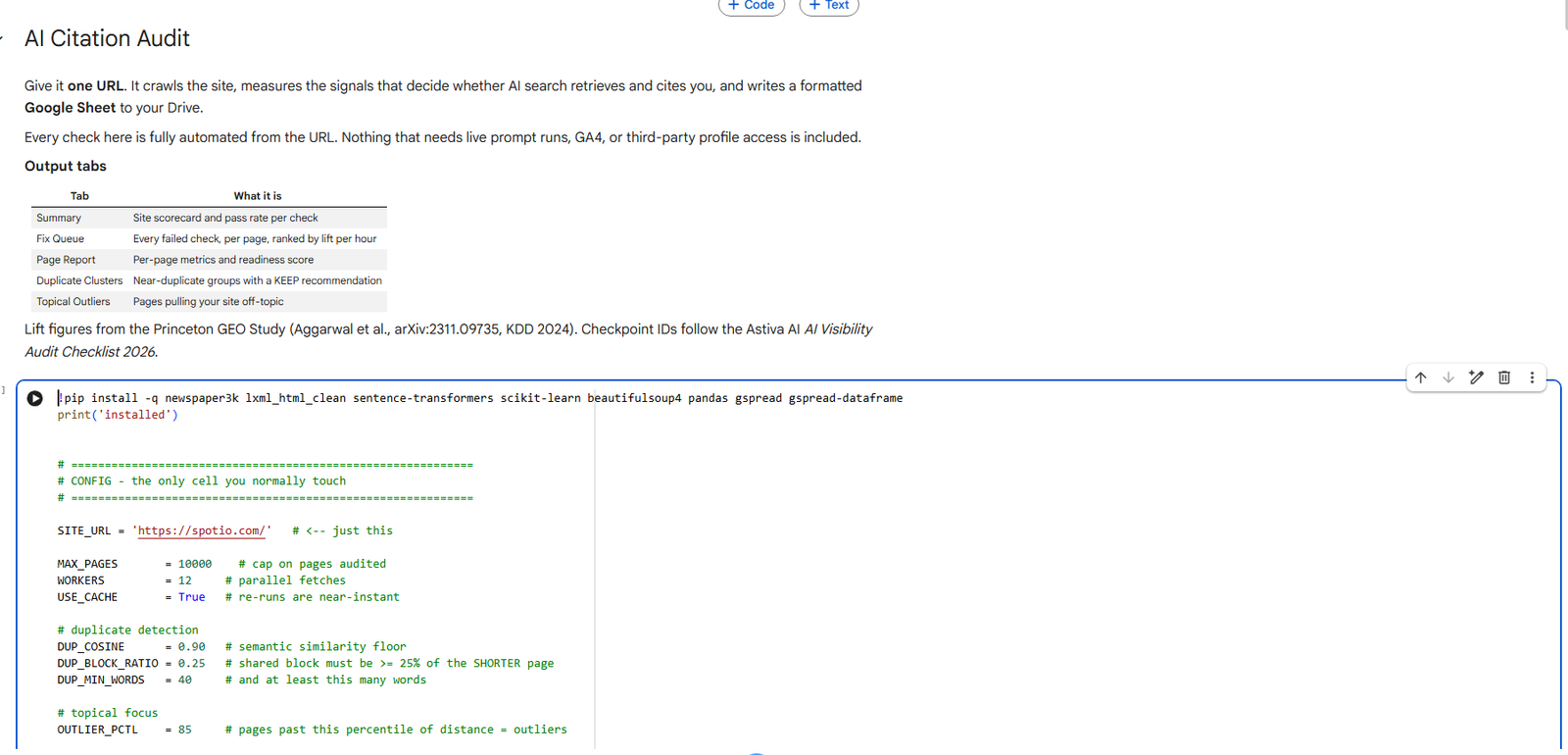
Replace SITE_URL with the site you want to audit. MAX_PAGES caps the crawl; 200 is fine for a first pass, raise it for larger sites.
2. Run all
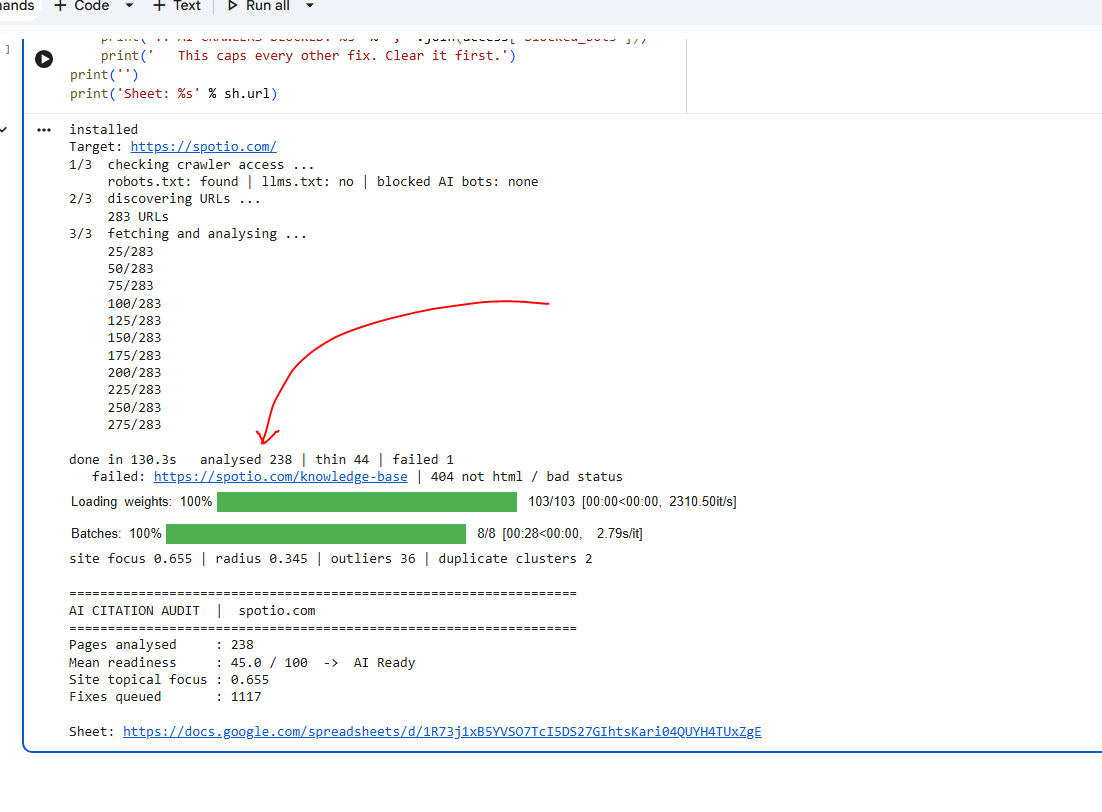
Colab asks once for permission to create a Google Sheet in your Drive. That is the only prompt. A 200-page site takes three to five minutes. Re-runs are faster because fetched pages are cached.
3. Read the Summary
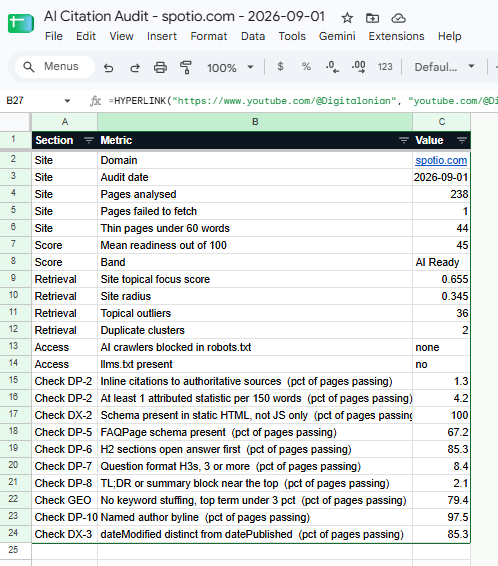
On the site in the screenshot, 100% of pages carry static schema and 97.5% have a byline, but only 1.3% cite an authoritative source and 4.2% attribute their statistics. The technical layer is fine. The sourcing is the gap, and sourcing is the highest-lift fix in the whole framework. That is the kind of finding the Summary is for.
4. Work the Fix Queue
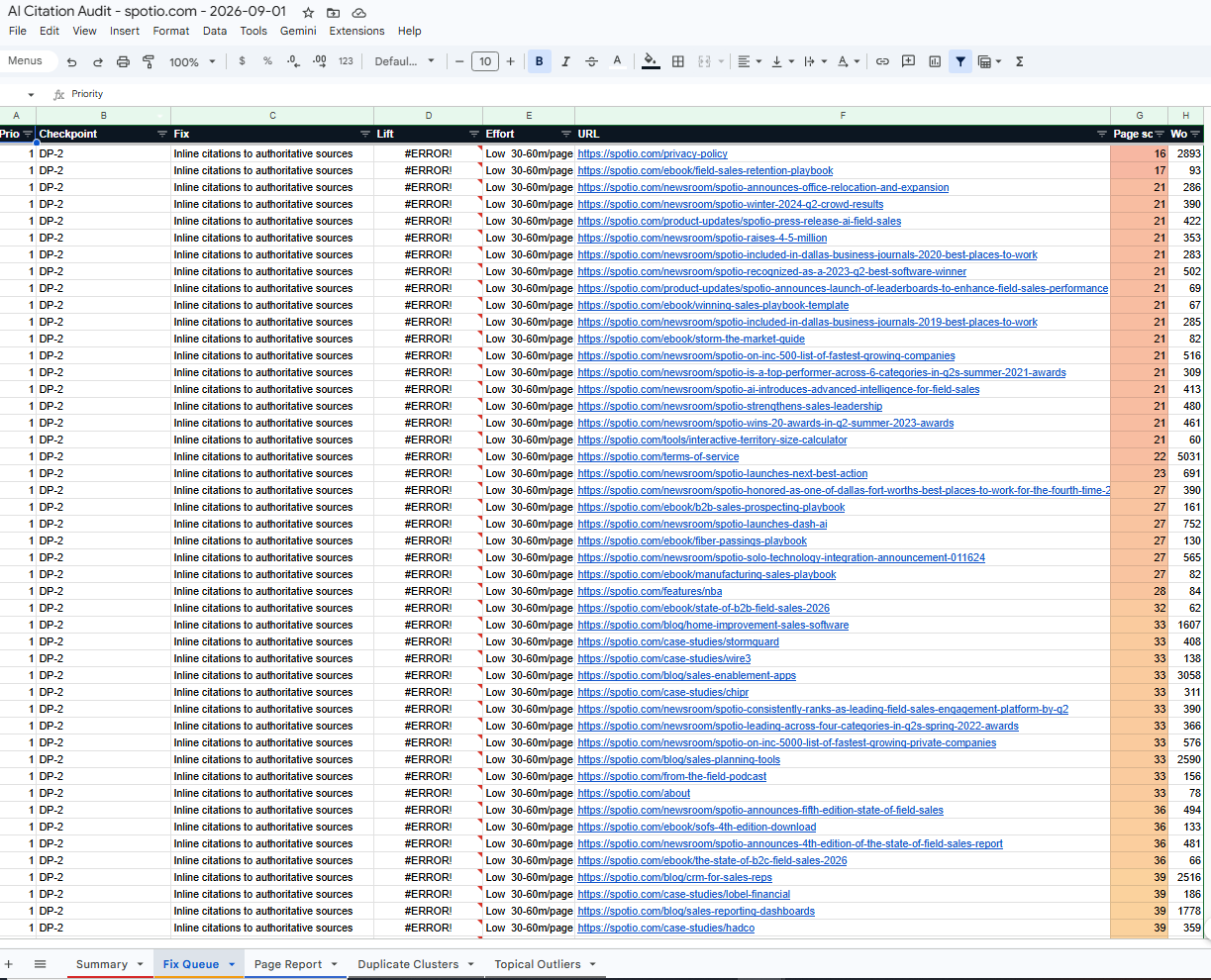
This is the tab you actually use. Each row carries the checkpoint ID, the measured lift and the effort estimate. Filter by checkpoint to batch the same fix across many pages at once.
5. Drill into pages
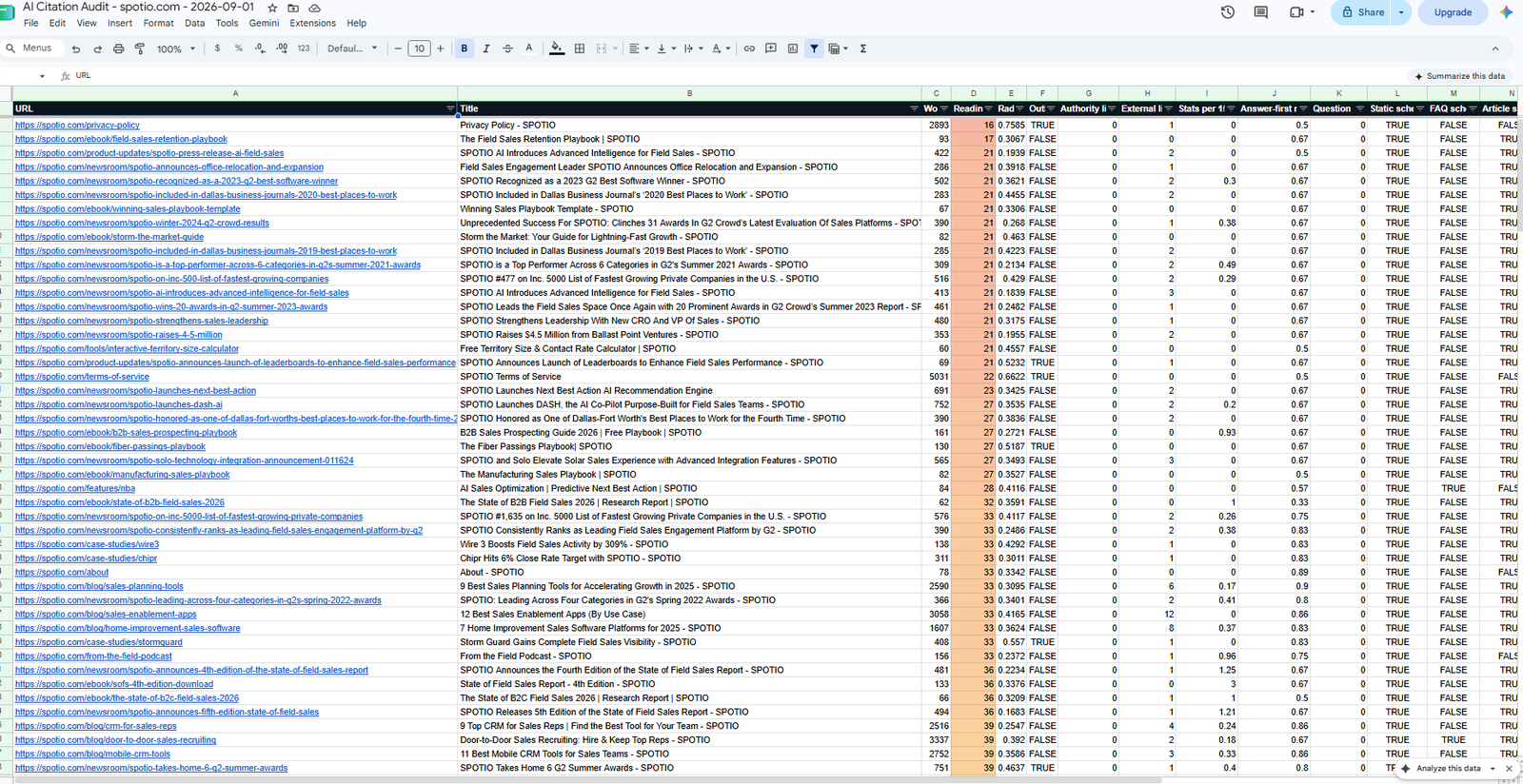
6. Consolidate duplicates

Found by embedding similarity, then confirmed by shared text so templated pages do not trigger it. A group of eight pages becomes one cluster with one recommendation, not twenty-eight pairs.
7. Prune outliers
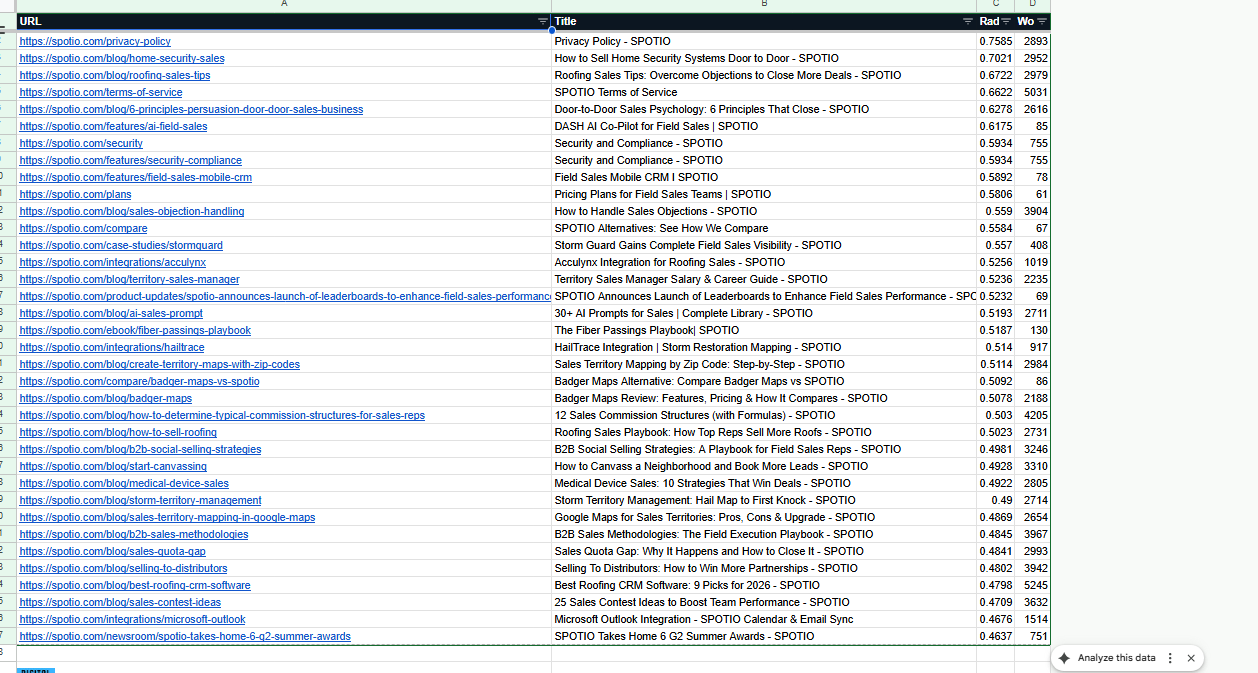
Some outliers are legitimate; a privacy policy will always sit far from the centre. The rest are the pages pulling your site off-topic, and pruning them is the cheapest way to move the focus score.
Do it without the tool: one export, one prompt
You don’t need the notebook for all of this. Four of the five signals are testable by hand with a crawl export and one prompt, and running it manually once is the fastest way to understand what the tool is actually checking. The two you cannot reach this way are Google’s internal effort estimate and its link-history data, which aren’t exposed to anyone.
Step 1 (2 min). Export your pages from any crawler. Screaming Frog’s free tier handles anything under 500 URLs. Keep four columns: URL, title, primary topic, publish date. Delete the other sixty. The model reasons better over less.
Step 2 (1 min). Add one column by hand: Original? Mark Y only if the page contains something that exists nowhere else. Your own data, your own screenshots, a client result, a number you generated. Mark N for everything else. Be harsh. Most people mark 80% Y on the first pass and about 20% on the honest second pass, and the second pass is the one worth having.
Step 3 (5 min). Paste this in:
You are auditing a website for retrieval quality in AI search.

Here is a list of pages with URL, title, primary topic, publish date,
and whether the page contains original material found nowhere else.

[PASTE TABLE]

Do four things.

1. TOPICAL FOCUS. Cluster these pages by subject. Tell me what
   percentage sit in the largest cluster, and list every page that
   is an outlier from the site's dominant subject. Do not soften
   this - outliers dilute the site's topical identity.

2. QUALITY SPREAD. Split the pages into three bands by how much
   original material they carry. Tell me what share of the site
   sits in the weakest band, and name the ten pages I should
   prune, merge, or rewrite first.

3. REDUNDANCY. Identify any group of pages that would give an AI
   assistant the same answer. For each group, name which single
   page should survive and why.

4. CITATION GAPS. Based only on the topics present, name five
   questions a reader in this niche would ask an AI assistant
   that this site currently could not be cited for.

Output as four short tables. No preamble. Be specific about URLs.
Step 4 (2 min). Read section 2 first, then section 4. Section 2 is your pruning list. Section 4 is next quarter’s content plan, and it tends to beat a keyword tool, because it comes from what your site doesn’t cover rather than from what has volume.
Sections 1 to 3 map onto focus, quality spread and information gain. Section 4 is the one that turns the audit into work.
Running it monthly
The manual version is enough for one site. Across several, the automation is four pieces: a scheduled crawl writing into a sheet, the sheet as input, the prompt above as one API call, output appended as a dated tab. A few cents a month on any of the usual no-code schedulers.
Two things worth building in. Diff each run against the last, so you can see whether your outlier percentage is actually moving. And keep the prompt in the sheet rather than buried in the automation, so you can change it without touching the pipeline.
If you want the crawl-side companion to this, I wrote up the full technical version separately: how to automate technical SEO audits with AI. Same 5-minute shape, aimed at crawl health rather than retrieval.
What I’d change tomorrow
Prune before you publish anything new. Deleting your weakest quartile moves your quality spread more cheaply than writing does.
Pick one subject and stay inside it for a full quarter. Focus is the only signal here where a five-page site competes on equal terms.
Put one non-reproducible thing in every page. A screenshot, a number, a test you ran. It’s the raw material citations are made from.
And stop writing the guide that already exists four times. Write the part those four skip.
FAQs
What are Google’s hidden ranking signals?
Signals stored in Google’s index that were not part of public guidance, revealed through the May 2024 Content Warehouse API leak, DOJ antitrust testimony, and Google’s patents. They include site-level topical focus scores, a standard deviation of page quality across a site, and a model-generated estimate of content effort.
Did Google admit to using click data?
In the 2023 antitrust trial, Google’s VP of Search testified about Navboost, a system that re-ranks results using aggregated click data over a rolling 13-month window, describing it as one of the important signals.
How does AI search decide which sources to cite?
AI Overviews and AI Mode retrieve documents from Google’s Search index before generating an answer, so the signals governing retrieval govern citation. The strongest are topical focus, quality consistency, estimated content effort, and how much new information a page adds relative to sources already shown to that reader.
Do these signals affect ChatGPT or Perplexity citations?
Not directly. Those run separate crawlers and retrieval stacks. The underlying principles carry over, since most retrieval systems reward focus and originality, but the field names are Google’s alone.
Is there a Google sandbox for new sites?
The hostAge field is scoped in the leaked documentation to sandboxing fresh spam, not new sites generally. On this evidence, new sites are not suppressed and can be cited by AI search.
What’s the fastest signal to improve?
Topical focus. Pruning or de-indexing off-topic pages shifts your site’s topical identity within a crawl cycle and requires no new writing.
Sources
- Google Content Warehouse API reference v0.4.0 — QualityNsrPQData, QualityNsrNsrData, QualityAuthorityTopicEmbeddingsVersionedItem, PerDocData
- US11354342B2 — Contextual estimation of link information gain
- US7346839B2 — Information retrieval based on historical data
- Search Quality Rater Guidelines, 11 September 2025
- Zyppy SEO — schema markup citation likelihood study
- Mike King / iPullRank — Secrets from the Algorithm
- Hobo — Key strategic SEO insights from the DOJ v. Google antitrust trial
Disagree with any of this?
If you’ve checked one of these fields and read it differently, I want to know — corrections make the next teardown better. Same form if you’d like Digitalonian to run the audit on your site instead.